
Running With Achilles Tendinitis: Is It Safe?
It’s a question that almost every runner with Achilles tendon pain asks eventually — can I keep running, or do I need to stop completely? The honest answer is that it depends. For some runners, carefully modified training can continue alongside treatment. For others, a temporary reduction in running load is necessary to allow the tendon to recover. What’s almost never the right answer is simply ignoring the pain and training through it as though nothing has changed. Doing so significantly increases the risk of the condition worsening — and potentially sidelining you for far longer than an early intervention would have.
At FIT Physiotherapy, our sports injury clinic in Newmarket works with runners and active individuals across York Region who are navigating exactly this situation. The goal is always to keep you as active as possible while giving the tendon what it needs to recover — and a physio assessment is the most reliable way to figure out where that line is for you specifically.
Understanding Why This Question Is Complicated
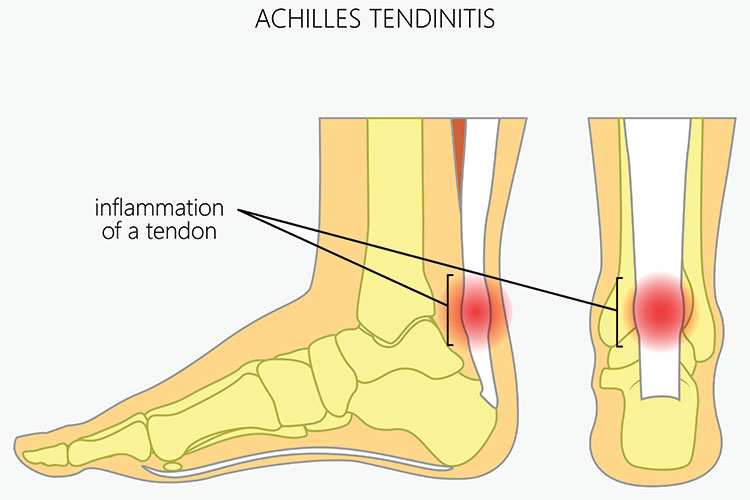
Achilles tendinopathy — the clinical term that covers Achilles tendon pain and dysfunction — is not a simple, uniform condition. It exists on a spectrum, from early-stage irritation that responds quickly to load modification, to more advanced tendon changes that require a careful, extended rehabilitation approach. Where you fall on that spectrum has a direct bearing on whether running is appropriate, and in what form.
The challenge is that many runners feel their pain “warm up” during a run — meaning the discomfort eases once they get moving. This can create a false sense that things are fine, when in reality the tendon is accumulating stress that may show up as increased pain later that day or the following morning. Pain that appears after exercise, or that is consistently worse the morning after a run, is an important signal that the tendon is not coping well with the current training load.
Signs That You Should Reduce or Pause Running
Your Pain Is Severe or Getting Progressively Worse
Mild, manageable discomfort that does not increase during or after a run is a different situation from pain that is climbing in intensity over days or weeks of continued training. If the pain is severe, consistently worsening, or beginning to affect your gait — how you walk or run — it is a clear signal that the tendon needs a period of reduced loading.
Your Pain Score Is Above a 3 or 4 Out of 10 During Running
A commonly used clinical guideline is that running with Achilles pain may be acceptable if discomfort stays at or below a 3 or 4 out of 10 during the activity and returns to baseline within 24 hours. Pain that exceeds this threshold during a run, or that leaves the tendon feeling significantly worse the next day, suggests the load is too high.
You Are Changing How You Run to Compensate
If you notice that you are unconsciously altering your stride, favouring one side, or shortening your push-off to avoid pain, the tendon is influencing your biomechanics in ways that can place additional stress on other structures — including the knee, hip, and lower back. Compensation patterns are a sign that it is time to reduce load and seek guidance from a physio.
You Have Significant Swelling or Thickening at the Tendon
Visible swelling, warmth, or a notable thickening of the Achilles tendon suggests a more significant level of tendon involvement. In these cases, continuing to run without assessment and a structured management plan is not advisable.
Your Symptoms Have Been Present for Several Weeks Without Improvement
Achilles tendon pain that has been present for more than a few weeks without meaningful improvement — despite your own attempts at rest, stretching, or ice — is telling you that a more structured approach is needed. Continuing to run without that structure is unlikely to lead to resolution on its own.
What to Do Instead of Running Through the Pain
Seek an Assessment at a Sports Injury Clinic
The most important step you can take is getting a proper assessment. A physio at a sports injury clinic can evaluate the nature and severity of your tendon condition, identify the contributing factors, and give you clear, specific guidance on what level of running — if any — is appropriate right now, and how to progress safely from there. Guessing your way through an Achilles tendon injury carries real risk; a structured plan does not.
Maintain Fitness With Low-Impact Alternatives
Reducing or pausing running does not have to mean stopping exercise altogether. Low-impact alternatives like swimming, cycling, or pool running allow you to maintain cardiovascular fitness and general conditioning without loading the Achilles tendon in the same way. Your physio can advise on which alternatives are appropriate for your specific situation.
Begin a Tendon Loading Program
The most evidence-supported treatment for Achilles tendinopathy is a carefully progressed tendon loading program — a series of specific exercises, typically beginning with slow, controlled calf raises, that gradually build the tendon’s capacity to handle load. This is the cornerstone of recovery and should be guided by a physio who can monitor your response and progress the program appropriately.
Address the Contributing Factors
Achilles tendinopathy rarely develops in isolation. Calf weakness, hip muscle deficits, running technique habits, footwear, and training load management all play a role. A physio assessment will identify which of these factors are most relevant to your situation so they can be addressed as part of your rehabilitation — reducing the likelihood of the problem returning once you are back to full training.
Non-Invasive Therapy Options for Achilles Tendinopathy
One of the advantages of working with a physio is access to a range of non-invasive therapy options that can support tendon recovery alongside the essential rehabilitation exercise work.
Shockwave Therapy
Shockwave therapy is one of the most evidence-supported non-invasive therapy options for Achilles tendinopathy, particularly for cases that have been present for several weeks or longer. It uses acoustic pressure waves directed at the tendon to stimulate the healing response and reduce pain, and has helped many runners who had previously struggled to make progress with exercise-based treatment alone.
Manual Therapy
Hands-on treatment directed at the calf muscles, ankle joint, and surrounding soft tissue helps to relieve muscular tension, improve mobility, and reduce the load being transferred to the Achilles tendon. It supports the tendon loading program rather than replacing it.
Acupuncture and Dry Needling
Acupuncture and dry needling can help manage pain and reduce calf muscle tension that may be contributing to excess tendon load. For runners who are managing discomfort between sessions, these techniques offer a drug-free option for symptom relief that complements the broader rehabilitation process.
Gait and Biomechanical Assessment
Adjustments to running technique — such as increasing cadence, reducing stride length, or modifying how the foot contacts the ground — can meaningfully reduce the load placed on the Achilles tendon. A physio with experience in running injuries can assess your gait and make specific recommendations that support your recovery and long-term performance.
How a Return-to-Running Program Works
Returning to full running after Achilles tendinopathy should be a graduated, structured process — not something that happens the moment the pain settles. A return-to-running program typically begins with low-intensity, shorter duration efforts on flat surfaces, progressing gradually in volume and then intensity based on how the tendon responds. The key principle is that the tendon needs to be progressively challenged in order to rebuild its capacity, but that challenge must be managed carefully to avoid setbacks.
Your physio will guide you through each stage of this process, adjusting the plan based on your response and ensuring that the contributing factors identified in your initial assessment have been adequately addressed before full training resumes. The goal is not just to get you running again — it’s to get you running consistently, without the injury recurring.
Get the Right Guidance From a Sports Injury Clinic in Newmarket
Running through Achilles tendon pain without a plan is one of the most common ways a manageable injury becomes a prolonged one. Whether your pain is recent or has been building for weeks, the most valuable thing you can do is speak with an experienced physio who can assess your situation and give you a clear, realistic path forward.
FIT Physiotherapy is a trusted sports injury clinic serving runners and active individuals throughout Newmarket and York Region. Our team provides personalized, non-invasive therapy in a supportive environment, with a focus on evidence-informed care and practical, achievable goals. We understand how much running matters to you — and we’re here to help you get back to it safely.
Contact FIT Physiotherapy in Newmarket today to book your assessment and take the right first step toward recovery.